Can New Dental Technology Help Your Teeth Repair Themselves? The Future of Biomimetic Dentistry
Nov 03, 2026New research is exploring how specially designed molecules could help protect teeth from decay, fight harmful bacteria, and support the body's natural repair processes. Here's what that means for your dental health.
Imagine visiting your dentist and discovering that a small area of early tooth decay could be treated without drilling, without removing healthy tooth structure, and potentially without needing a filling.
For many patients, that sounds like the future of dentistry.
But researchers are already investigating technologies that could bring us closer to that possibility.
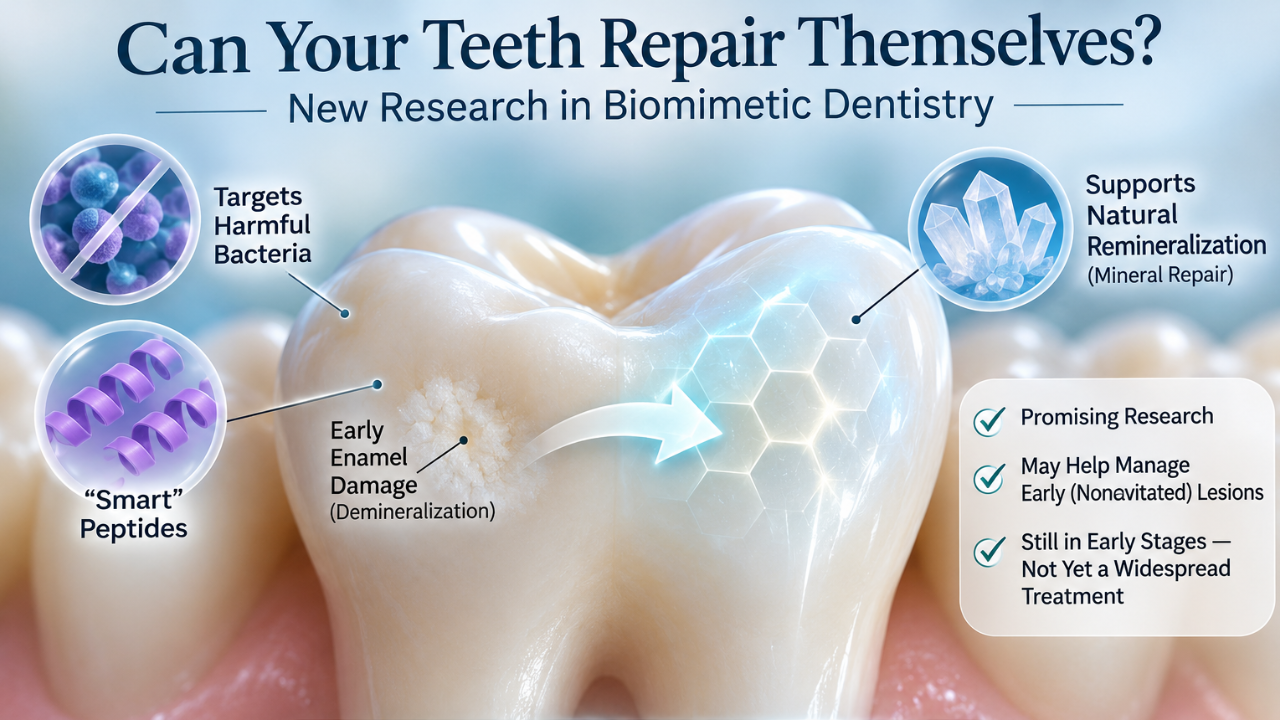
One particularly exciting area of research involves smart peptides, tiny molecules designed to interact with tooth surfaces, harmful bacteria, and the minerals that make our teeth strong.
An October 2026 review in the Journal of the American Dental Association (JADA) examined the potential for peptide-based systems to combine two important functions: controlling bacteria associated with dental disease and encouraging the remineralization of damaged tooth structure.
The findings are promising, although much of the technology remains in the early stages of development.
For patients interested in protecting their natural teeth, understanding this research offers a glimpse into where modern dentistry may be heading.
And perhaps more importantly, it highlights something we already believe in: the best dentistry preserves as much of your natural tooth as possible.
Your Teeth Are Strong, But They're Not Indestructible
To understand why this research matters, it helps to understand how teeth become damaged in the first place.
Your teeth are covered by enamel, the hardest substance in the human body.
Enamel is primarily made of minerals, especially a crystalline form of calcium phosphate called hydroxyapatite. You've probably heard this term as an ingredient in some toothpastes that are becoming increasingly popular. This highly organized mineral structure allows teeth to withstand years of chewing, temperature changes, and exposure to the foods and beverages we enjoy.
But enamel faces a constant challenge.
Every day, bacteria in dental plaque metabolize certain carbohydrates and produce acids. Those acids can gradually dissolve minerals from the tooth surface.
This process is called demineralization.
Fortunately, your mouth has natural defenses.
Saliva helps neutralize acids and supplies calcium and phosphate that can be incorporated back into weakened enamel. There are other products that can also support and aid remineralization and make enamel more resistant to future acid attacks.
This natural repair process is called remineralization.
Throughout the day, your teeth experience a continuous balance between mineral loss and mineral recovery.
When mineral loss consistently exceeds recovery, tooth decay can develop.
The important distinction is that not every area of early decay requires a filling.
When a lesion is still in its early stages and the tooth surface remains intact, there may be an opportunity to stop or reverse some of the mineral damage through appropriate preventive care.
That's where the next generation of dental technology becomes especially interesting.
What Are Smart Peptides, And Why Are Researchers Excited About Them?
Peptides are short chains of amino acids, the same basic building blocks that make up proteins throughout the human body.
Scientists can design certain peptides to perform highly specific functions.
In dentistry, researchers are exploring whether these molecules could help solve two problems at the same time.
First, they may help control harmful bacteria.
Certain antimicrobial peptides can interact with bacterial cells or biofilms. Researchers are studying how to use these properties to reduce bacterial activity associated with tooth decay while minimizing unwanted effects on the oral environment.
Second, they may help guide mineral formation.
Other peptide systems are designed to interact with calcium and phosphate or organize structures that encourage mineral deposition.
Some self-assembling peptides can form microscopic scaffolds that researchers hope will support remineralization within early enamel lesions.
The particularly interesting concept is combining these functions into one system.
Rather than simply repairing the consequences of bacterial acid production, future treatments might help manage the bacterial environment while supporting mineral recovery.
That represents an important direction in dental research.
Instead of focusing exclusively on repairing damage after it occurs, scientists are investigating ways to intervene earlier in the disease process.
However, there is an important distinction between a technology that performs well in laboratory studies and one that has been proven to provide predictable long-term benefits for patients.
The October JADA review emphasized that much of this research remains preclinical, with emerging animal and early clinical evidence.
In other words, the science is encouraging, but these technologies are not yet a universal replacement for established dental treatments.
Could This Mean Fewer Fillings in the Future?
Possibly, particularly when tooth decay is detected early.
Traditionally, many patients think of cavities as a simple choice: either you have one or you don't.
But tooth decay is actually a progressive process.
A small area of enamel demineralization is very different from a large cavity that has already destroyed substantial tooth structure.
Consider two examples.
Scenario One: An Early Area of Enamel Damage
A patient comes in for a routine dental examination.
During the examination, we identify a small area of mineral loss on a tooth. The enamel surface is still intact, and the lesion has not developed into a physical cavity.
Depending on the location, activity, age, and other risk factors, this area may be managed with preventive treatments and careful monitoring.
That might include supplements, clinical applications, dietary adjustments, improvements in plaque control, ozone, or other evidence-supported nonoperative therapies.
As peptide-based technologies continue to develop, they may eventually provide additional ways to manage these early lesions.
The goal would be to preserve the tooth without unnecessarily removing healthy enamel.
Scenario Two: A Larger Cavity With Structural Damage
Now consider a tooth with a cavity that has progressed beyond the early stages.
The tooth may have lost enamel, developed a physical opening, or experienced damage extending into the underlying dentin.
In this situation, remineralization alone may not restore the missing structure or adequately address the disease.
A restoration may still be necessary.
And this is where biomimetic restorative dentistry becomes particularly valuable.
Rather than automatically removing large amounts of tooth structure, the objective is to preserve healthy tissue while restoring the tooth's function, strength, and structural integrity.
Although it would be amazing if possible, the future of dentistry is not necessarily about eliminating fillings. But rather, it's more about understanding when a filling is truly necessary and preserving more of the natural tooth whenever possible.
What Is Biomimetic Dentistry?
Biomimetic dentistry is an approach to dental care that emphasizes preserving natural tooth structure and restoring damaged teeth in ways that respect their original biological and mechanical properties.
The word biomimetic essentially means imitating nature.
Natural teeth are remarkable structures.
Enamel is hard and wear-resistant. Dentin underneath is more flexible and helps support the enamel. The connection between these tissues contributes to the tooth's ability to withstand the forces of everyday chewing.
When a tooth becomes damaged, the objective of biomimetic restorative dentistry is to preserve and restore as much of that natural structure and function as possible.
This approach may involve carefully removing diseased tissue, using adhesive bonding techniques, protecting remaining healthy enamel and dentin, and choosing restorations appropriate to the amount and location of damage.
In some situations, a bonded onlay or partial-coverage restoration may preserve more tooth structure than a traditional full-coverage crown.
In others, a small direct restoration, or 'filling', may be sufficient.
And in the case of the October JADA article, sometimes, the most appropriate treatment is to avoid surgical intervention altogether and treat the infected early lesion with conservative approaches.
The central principle is simple:
Preserve what is healthy. Treat what is damaged. Avoid unnecessary removal of natural tooth structure.
That philosophy connects directly with the emerging peptide research.
Both emphasize finding ways to maintain natural teeth rather than simply replacing damaged portions.
Why Early Detection Matters More Than Ever
One of the most important lessons from this research is that the timing of treatment can make a significant difference.
An early area of enamel demineralization may offer opportunities for preventive care that are no longer possible once the tooth has developed a large cavity.
That's why regular cleanings, dental examinations, and X-rays are about much more than simply checking whether you need a filling. Lots of times, we can still intervene with these smaller beginning type areas.
During an examination, your dentist may evaluate changes in enamel appearance, existing restorations, areas of plaque accumulation, and your individual risk factors for tooth decay.
Dental radiographs can also help identify certain lesions that may not be visible during a clinical examination.
For early lesions, careful documentation can be especially valuable.
By comparing findings over time, your dentist can better determine whether an area appears stable, is improving, or is progressing.
That information helps guide the decision between continued preventive management and restorative treatment.
And it becomes even more important as new remineralization technologies enter clinical practice.
A treatment should not be considered successful simply because it sounds innovative.
Its effectiveness should be evaluated through meaningful clinical findings and appropriate follow-up.
What Can Patients Do Today To Help Their Teeth Remineralize?
While researchers continue studying peptide-based treatments, there are already established ways to support enamel health and reduce the risk of tooth decay.
The most effective strategy is generally a combination of good home care, appropriate preventive treatment, and regular professional evaluation.
Pay Attention to How Often And When You Consume Sugar
The frequency of sugar exposure can be just as important as the amount consumed.
Sugar in and of itself, isn't bad. But what it is, is a food source for the bacteria. Each time certain oral bacteria metabolize sugar, they can produce acids that contribute to enamel demineralization.
Frequently sipping sweetened beverages or snacking throughout the day can create repeated acid attacks and challenges that can ultimately lead to decay. These frequent attacks can still accumulate and do permanent damage even if you are a 'regular' brusher.
Reducing the frequency of these exposures gives saliva more opportunity to help restore a healthier environment, especially between your brushing cycle.
Support Healthy Saliva Production
Saliva plays an essential role in protecting your teeth.
It helps neutralize acids, wash away food particles, and supply minerals involved in remineralization.
Dry mouth can increase the risk of tooth decay, particularly around exposed root surfaces and existing restorations.
Don't Ignore Small Changes
A white or chalky area on a tooth can sometimes indicate early mineral loss.
However, not every white spot represents active decay.
Changes in tooth color, sensitivity, or texture deserve professional evaluation rather than self-diagnosis.
It's always better to treat smaller issues rather than larger ones and to be more proactive instead of being reactive. Identifying a problem early may allow for more conservative treatment.
Keep Up With Regular Dental Examinations
Routine examinations and cleanings provide opportunities to identify developing problems before they become more extensive.
They also allow your dentist to monitor previously identified areas and evaluate whether preventive strategies are working.
The appropriate examination and radiograph (X-rays) schedule should be based on your individual oral health and risk factors. For most of the patients out there, twice a year is still recommended.
Is Peptide-Based Remineralization Available Today?
Some peptide-based dental products have entered commercial use or early clinical evaluation, but it is important not to treat every product or technology as equally established.
Different systems may use different molecules, delivery methods, and biological mechanisms.
Some are designed primarily to support mineral deposition. Others focus on antimicrobial effects. Still others are experimental combinations of both.
The October 2026 JADA review highlighted the potential of multifunctional peptide systems while also identifying the need for stronger clinical evidence.
For patients, that means new technologies should be evaluated carefully.
Before choosing an emerging treatment, useful questions include whether the product has been studied in humans, what types of lesions were included in those studies, how outcomes were measured, and whether long-term results are available.
A treatment that works in a laboratory does not automatically produce the same results in a patient's mouth.
And a product that may benefit an early, noncavitated lesion should not be assumed to repair a tooth that has already lost substantial structure.
At our dental office, we believe innovative technology should complement sound clinical judgment rather than replace it.
The Bigger Picture: Dentistry Is Moving Toward Preservation
For decades, many advances in dentistry focused on improving how damaged teeth could be repaired.
We developed stronger restorative materials, more effective bonding systems, better imaging technologies, and increasingly precise treatment techniques.
Those innovations have made an enormous difference.
But another important direction is emerging.
Researchers are asking whether we can intervene earlier, support natural biological processes, and prevent some damage from becoming irreversible.
Peptide-based remineralization is one example.
Other areas of investigation include bioactive materials, improved approaches to managing dental biofilms, and technologies designed to interact more effectively with natural tooth tissues.
Not every experimental technology will become a routine dental treatment.
Some may prove too expensive, difficult to deliver, or insufficiently effective in clinical settings.
Others may eventually become valuable additions to preventive and minimally invasive dental care.
What's encouraging is the overall direction.
Modern dentistry is increasingly interested in preserving the natural tooth, managing disease earlier, and selecting treatments based on the actual condition of the tooth rather than automatically moving toward more extensive restorations.
These principles are central to biomimetic dentistry.
What Does This Mean for Your Next Dental Visit?
You don't need to wait for the next generation of dental technology to benefit from a more conservative approach to your oral health.
There are already meaningful questions you can ask when discussing treatment options with your dentist.
For example, is the area of concern an early lesion or an established cavity? Is the condition active or stable? Can it be managed preventively? If a restoration is necessary, how much healthy tooth structure can be preserved?
The answers will depend on the specific tooth, the extent of damage, your individual risk factors, and the available clinical evidence.
Sometimes the best choice are non-surgical treatments and monitoring to see if those treatments solve the issue.
Sometimes a small bonded restoration is appropriate.
And sometimes a tooth requires more extensive care to restore its function and protect its long-term health.
The important thing is that treatment should be individualized.
The goal isn't simply to do less dentistry. It's to provide the right dentistry, at the right time, while preserving as much of your natural tooth as possible.
A More Thoughtful Approach to Dental Care
At Dallas Designer Smiles, our philosophy is centered on preserving natural teeth and helping patients understand their treatment options.
We believe patients deserve to know not only what treatment is recommended, but why it may be necessary, what alternatives exist, and how different approaches may affect the long-term health of their teeth.
Emerging research into smart peptides and biomimetic remineralization reinforces the importance of that philosophy.
Although these technologies are not yet a universal solution for tooth decay, they represent an exciting direction for preventive dentistry.
The possibility of helping teeth retain or recover minerals, controlling harmful bacterial activity, and reducing the need for some invasive treatments is worth continued scientific investigation.
Until those technologies are more fully validated, the foundations of excellent dental care remain the same: early detection, evidence-based prevention, careful diagnosis, and conservative restorative treatment when needed.
Because the most valuable dental technology isn't necessarily the newest one.
It's the technology—and the clinical judgment—that helps you keep your natural teeth healthy for as long as possible.
Interested in a More Conservative Approach to Dental Care?
If you've been told you need a filling, crown, or other dental treatment, you may have questions about your options.
At Dallas Designer Smiles, we focus on biomimetic and minimally invasive restorative dentistry, with an emphasis on preserving healthy tooth structure whenever clinically appropriate.
Whether you're concerned about an early cavity, an aging restoration, or a damaged tooth, we're here to help you understand your options and make informed decisions about your dental health.
Schedule a consultation to learn more about our approach to preserving natural teeth.
COME SEE HOW WE CAN TRANSFORM YOUR LIFE