Told You Need a Crown? Why It's Worth Asking About an Onlay
Nov 10, 2026By Dr. Jeff Davies, DDS
If you've been told you need a crown, you may have another option. Many teeth that get a crown recommendation can be considered for an onlay, a smaller restoration that keeps more of your natural tooth. Whether yours is one of them takes an exam to answer, and that's what a second opinion is for.
As a biomimetic dentist, I lean toward onlays over crowns whenever the tooth allows it. Your dentist's crown recommendation isn't a bad approach. Crowns have helped a lot of people keep their teeth. It's just not where we start.
What's the difference between a crown and an onlay?
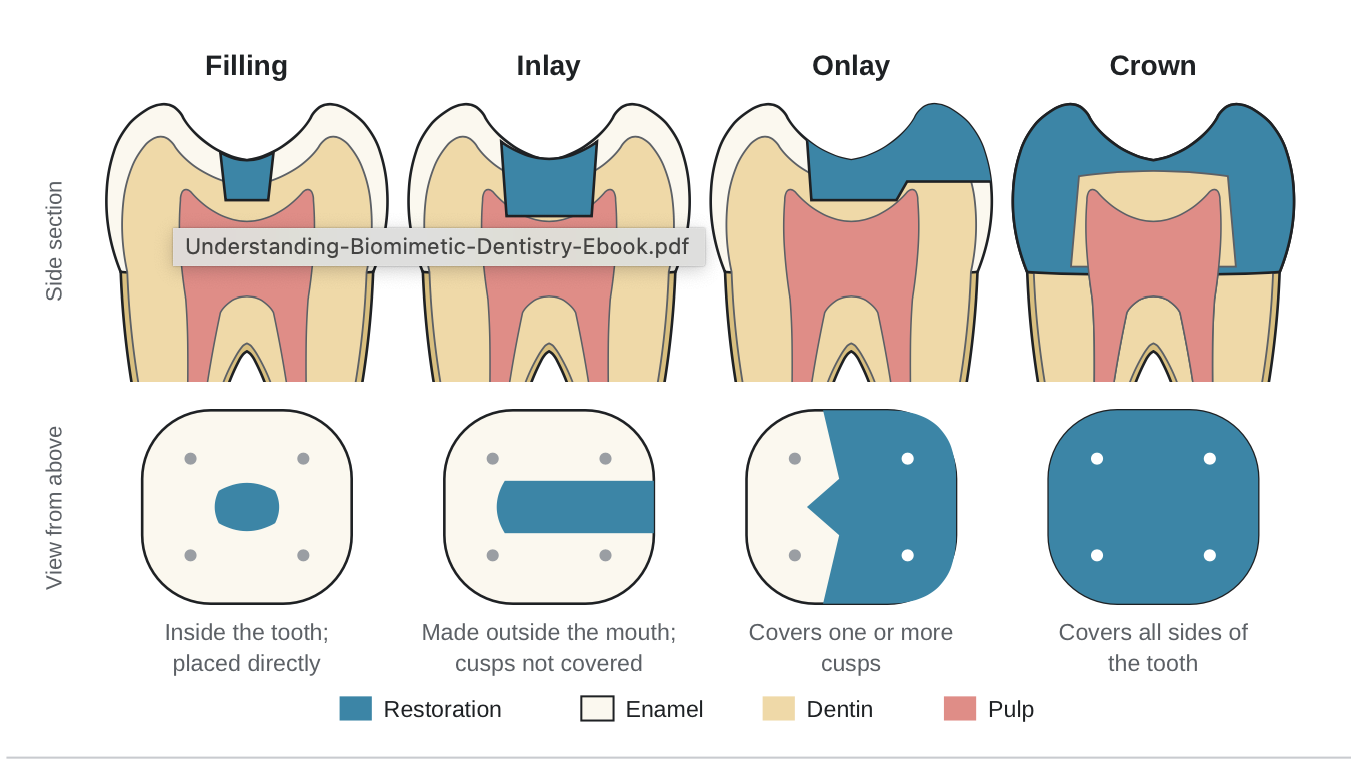
A crown is a tooth-shaped cap that covers the whole tooth above the gum line. To make room for it, the tooth is shaped down on all sides, including the parts that may still be healthy.
An onlay, sometimes called a partial crown, covers only the part of the tooth that needs it. That usually includes one or more cusps, the raised points on the chewing surface. The healthy walls of the tooth can stay where they are, and the onlay is bonded to what remains.
The difference in tooth removal can be significant. In one study cited by recent reviews, full crown preparations removed about 68% to 76% of tooth structure, compared with about 36% to 47% for partial coverage. Those figures come from particular preparation designs, so they aren't a measurement of your tooth. They do show why this question is worth asking before any drilling begins.
Why does biomimetic dentistry favor saving tooth structure?
Biomimetic means imitating nature. Your tooth is built with hard enamel on the outside and a more flexible layer called dentin underneath. Biomimetic dentistry aims to remove what's damaged, keep what's healthy, and bond the restoration to the tooth so the two work together.
Tooth structure is also the one thing we can't put back. Once healthy enamel has been cut away for a crown, it's gone for good. Saving it gives you a kind of backup plan. If that restoration ever needs to be redone, there's more natural tooth left to work with.
That leads to a difference in thinking you may notice between offices. You might hear, "There isn't enough tooth left for an onlay, so you need a crown." My philosophy runs the other way. The more compromised a tooth is, the more conservative and precise I want to be with what's left.
How do onlays compare with crowns?
The research on tooth-colored onlays is encouraging, with some real limits.
- A 2022 review found no statistically significant difference in survival between onlays or partial crowns and full crowns at one and three years. The authors concluded that onlays performed as well as crowns in the short term, though most of the evidence was observational.
- The same review describes studies of large ceramic onlays used on teeth with substantial damage, with good results at three to five years.
- A 2024 review of partial coverage restorations called them a reliable option for back teeth with extensive damage, while saying their long-term performance is still uncertain.
So I can't tell you an onlay always lasts longer or that it will prevent a root canal. What the research supports is more modest, and still meaningful: in the short-term studies, onlays held up about as well as crowns while removing less tooth.
Onlays also ask more of the dentist. Bonded restorations tend to be more technique-sensitive than crowns and depend on keeping the tooth clean and dry, using magnification, and following a careful bonding process. That's one reason to ask how often an office places them.
What about a cracked tooth or a large old filling?
These are two of the most common reasons people hear "you need a crown," so they're worth a closer look.
Cracks. Not all cracks are alike. Spear Education's clinical overview describes a range from craze lines, which stay in the enamel and are usually only a cosmetic concern, to split teeth, which often can't be saved. In between are fractured cusps and cracked teeth. A crown has traditionally been the most established way to cover a crack. Bonded restorations are a more conservative alternative, and the same overview describes their results as still developing but promising. A cracked tooth has an uncertain long-term outlook with any restoration, including a crown, and you should hear that from any dentist treating one.
Large old fillings. A big filling can leave the walls around it thin and unsupported, which is often why a crown comes up. Sometimes the full picture only appears once the old filling is out, because that's when a crack can be properly assessed. The plan may change at that point, and it's fair to ask about that ahead of time.
Can every tooth have an onlay?
I'd argue that essentially yes, if the treatment is warranted. As mentioned above, the more compromised a tooth is the more selective and careful I'm trying to be when we need to do a larger restoration. That being said, each only will have its own configuration of how it looks. That configuration is based off what needs to get removed. Anything that is poor, not functional, not supporting, cracked or otherwise damaged will need to be removed. That also means, just those areas and extending further into the tooth than what is absolutely necessary. So even if a tooth is badly beat up, there is still a good chance a version of an onlay would still be a great choice for how to restore that tooth. That being said, a split tooth that is fractured in half may need to come out entirely.
For many other problems, recommendations vary. In that same national study of 1,777 dentists, dentists differed in how likely they were to recommend a crown. Two careful dentists can look at one tooth and propose different plans. That's a good reason to hear both.
What happens at a second opinion?
We start by listening to your story, your symptoms, and your goals. Then we look at the tooth closely using photos, digital scanning, X-rays, and magnification, and show you what we're seeing. If you have records from your dentist, please bring them.
You'll leave knowing whether an onlay looks like a reasonable option for your tooth and what the tradeoffs are. If a crown is the better choice, I'll tell you that too. Photos, X-rays, and symptoms can't settle this on their own, which is why an exam matters.
How soon should you decide?
That depends on what's going on with the tooth, so ask your dentist how urgent it is and what could happen if you wait. In many cases, there's time for a second visit. If you have severe pain, swelling, or a broken tooth, call a dentist promptly.
What should you ask before saying yes to a crown?
- What exactly did you find on this tooth, and can you show me?
- Why a crown instead of an onlay, and what finding rules out the more conservative option?
- How much healthy tooth would each option remove?
- What could happen if I delay treatment, and how soon would you want to act?
- If this restoration ever fails, what would the next step be?
Sources
- MedlinePlus: Dental crowns
- National Dental PBRN: Do You Need a Crown?
- Wang et al., Head & Face Medicine, 2022
- Prott et al., Journal of Esthetic and Restorative Dentistry, 2024
- Spear Education: types of tooth cracks
Wondering if an onlay could work for your tooth?
If you're in Dallas or Highland Park and you've been told you need a crown, request a second opinion before you decide. We'll look at your tooth together and talk through whether an onlay is an option.
COME SEE HOW WE CAN TRANSFORM YOUR LIFE